
Sequoyah Jail Release Destinations
Sequoyah County Jail, also called the Sequoyah County Justice Center, is the immediate source for a local booking and movement out. A person may leave on bond or recognizance, after dismissal, for time served, or at the end of a county sentence. Those events end the jail’s custody for that booking. They do not erase the court case or prove that all other holds have ended.
Another exit is a transfer. The person may move to Oklahoma Department of Corrections custody, another county, federal or tribal custody, a hospital, or immigration custody. In that setting, “released by the jail” means one custodian’s control ended while another began. The sheriff’s release or transfer record should name the event and destination. Then check the receiving agency.
| Jail exit | What it means | Best next record |
|---|---|---|
| Bond or recognizance | The booking custody ended while the criminal case continues | Sheriff release record and signed court order |
| Time served or sentence complete | The relevant term may be complete, subject to other holds | Release record, judgment, and commitment |
| Dismissal | A charge or case ended as ordered, but another case may remain | Dismissal order and jail movement record |
| Transfer | Custody continued under another agency | Jail destination field and receiving locator |
Note: A person who disappears from the current roster may have been released, transferred, or affected by an update mismatch.
Confirm Sequoyah County Jail Releases
The Sheriff’s current inmate roster answers one question: does the Sheriff report the person in county custody now? It updates hourly and shows people only while in custody. A nonmatch does not identify the time, authority, or destination of the exit.
Use a short, source-based sequence. Match more than a name because people can share one.
- Search the current roster and save the exact name, date of birth or age, booking number, booking time, charge, and case number when shown.
- If the card is absent, search the same person in Oklahoma VINE. Read the reporting agency and whether the event says release or transfer.
- Call the jail at 918-776-9028 when timing or identity remains unclear. Ask whether public information can confirm release or transfer.
- Check the OSCN court docket for bond, dismissal, judgment, sentence, release order, warrant, or other case action. Obtain the signed order when its terms matter.
- Request the sheriff’s booking and release record. If it reports transfer, continue with ODOC, another jail, federal court or custody, or ICE as the destination requires.
For a named-person search across custody systems, the Sequoyah County released-inmate record path shows how county, state, court, federal, and notification records fit together.
Identity checks should use the booking or case number with date of birth, age, middle name, and other available details. A photograph can help distinguish two people, but it belongs to a specific booking and does not show the later case result. If VINE and the jail record appear to conflict, note each agency, status label, and event date before asking the Sheriff to resolve the county movement.
Sequoyah Jail Roster Limits
The public roster sorts people by booking date and provides current booking cards, details, and photographs. Its live detail fields can include name, booking time and number, sex, race, age or date of birth, classification, charges, and a booking image. Those fields describe a booking and present jail custody. They are not a released-person archive.
The Sheriff’s official data guidance says the roster updates hourly and contains people only in custody. No release-retention interval is stated. Daily and weekly media reports are arrest or booking reports, not exit reports. Likewise, the Sheriff’s mobile app advertises inmate information, booking detail, and recent arrests, but it does not document a release feed.
A blank internal release-date property observed on current records does not create a public release search. Once a card drops off, the durable source is the existing jail-register or booking and release record. A cached result can be stale and should not substitute for the Sheriff’s current data.
Sequoyah Jail Records and Contact
The Sheriff operates the county jail and maintains the local booking and exit record. Use the jail number for a current timing question and the Records Division for a document request. The official Records page states that walk-in access is available on weekdays during its posted records hours. It does not publish a general email, online booking-release form, universal copy price, photo fee, or promised completion time.
Sequoyah County Sheriff and Jail
119 S. Oak St.
Sallisaw, OK 74955
Jail: 918-776-9028
Sheriff: 918-775-1214
Dispatch: 918-775-9155
Fax: 918-775-1219
Records walk-in hours: Monday through Friday, 9 a.m. to 3 p.m.
The Sheriff Records Division source is captured below with its access limits and posted hours.
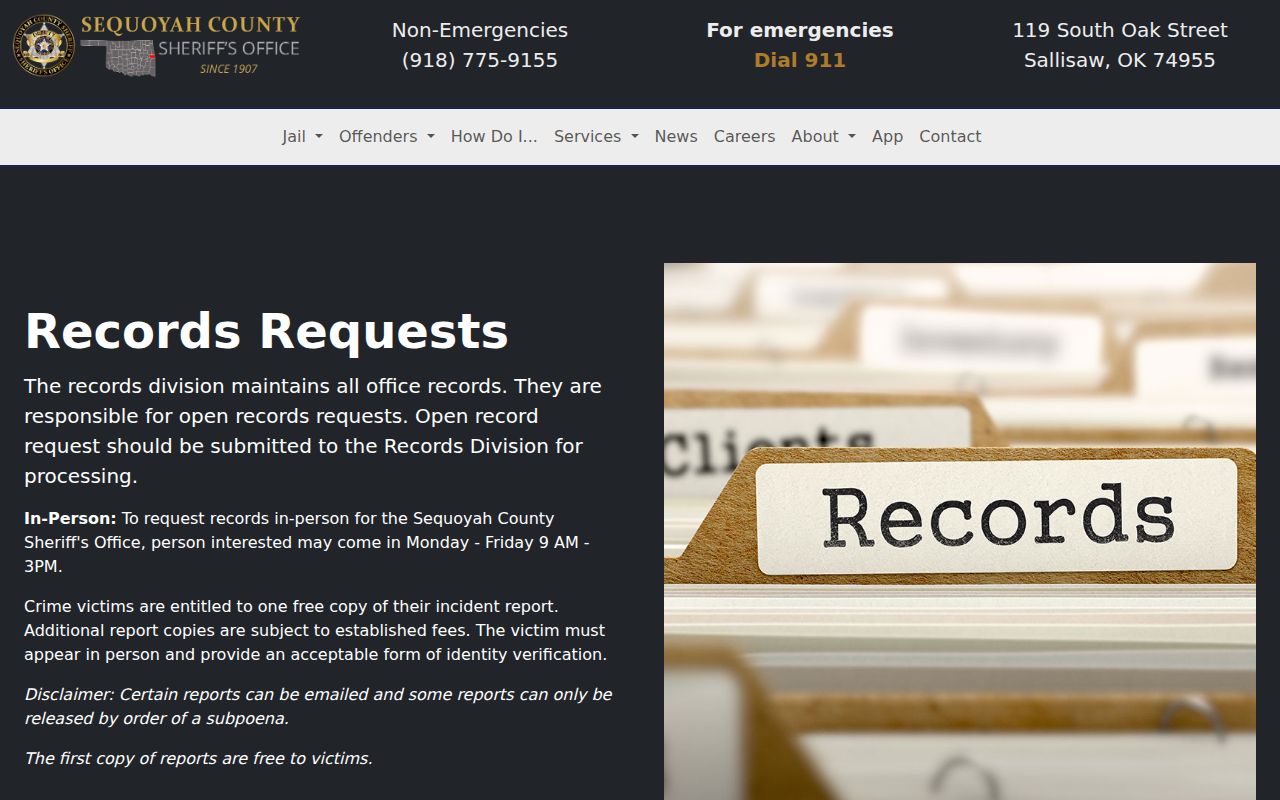
The screenshot supports the contact route, but the requester should still confirm current hours, cost, and delivery before travel or payment.
Note: The jail administrator’s name can change more quickly than the agency address, so use the office title in a request.
Sequoyah Jail Release Record Fields
A focused request is more useful than asking for all inmate information. Give the full name, suitable date of birth, approximate booking date, booking number, arresting agency, and court case number when known. Ask for existing records rather than a new custom report.
The requested fields should tie one person and one booking to the exact terminating event.
- Booking number, arresting agency, booking date, and booking time
- Charges tied to that booking and related case identifiers
- Release date, release time, and release type or authority
- Bond or court order when it forms part of the releasable record
- Transfer destination or receiving agency when custody continued
- Booking photograph, subject to availability, redaction, and lawful access limits
Under 51 O.S. §24A.8(A)(8), a jail register, if kept, includes the date or manner of discharge or escape among its public inspection and copying fields. That makes a jail-register request more precise than asking why a person vanished from the website. If a field is exempt, request redaction and production of the rest.
Oklahoma law does not impose one fixed completion period for every request. Access must be prompt and reasonable, but record location, review, redaction, and lawful fees affect timing. Ask for a written estimate. Ordinary paper-copy charges are governed by current §24A.5 limits unless another law applies, but the statutory cap is not proof of the Sheriff’s actual cost for an electronic booking record or photograph.
Sequoyah Jail Releases to ICE
A February 2026 Public Radio Tulsa report documented an immigration-related detention instance at Sequoyah County Jail. It shows why the end of a local criminal hold may lead to transfer or continued immigration custody rather than return to the community. The report does not establish a standing ICE contract, a 287(g) agreement, or a general county policy.
When immigration transfer is plausible, ask the Sheriff’s record for the release type and destination. Then check the ICE Online Detainee Locator System by A-number and country of birth, or by exact biographical fields. A recent move can lag. Spelling, age, country of birth, and the limits of the locator can also affect the result.
A local release and an ICE nonresult still do not prove community release. Follow current ICE guidance or the responsible ERO contact when the record names ICE but the public locator does not resolve the person. Keep the county transfer record because it documents where the Sheriff reported custody went next.
Note: This documented instance supports a transfer warning only; it does not prove an ongoing countywide immigration arrangement.
Sequoyah Jail History in Context
A 2006 Oklahoma corrections audit described the jail as a 116-bed trust-authority facility. It also reported that the facility had contracted in 2005 to house 38 minimum-security ODOC men from Jim E. Hamilton Correctional Center as jail trustees. These figures belong to that dated historical record.
The audit is not proof of the jail’s present capacity, operator structure, contract status, or population. It should not be used to estimate current releases or claim that the old ODOC arrangement still exists. Current custody and release questions must return to the Sheriff’s roster, jail record, and official contacts.
The 2006 Oklahoma Corrections audit archive provides the historical source. Date labels preserve useful local context without turning an old arrangement into a current fact.
Follow Sequoyah Jail Transfers
A state sentence can move a person from the county jail to an ODOC facility elsewhere. That movement is not an ODOC discharge. Search ODOC by the person’s number when available, match the Sequoyah case, and read the current status and facility together. A later parole or discharge is documented in the state system.
For another county jail, use the receiving county’s official roster and records office. Federal pretrial movements may require the federal docket or U.S. Marshals contact because the BOP locator is not a full pretrial database. A sentenced federal prisoner may later appear in the BOP locator. Tribal or hospital records may have different access limits.
The court file supplies legal context, such as the bond order, dismissal, judgment, sentence, or warrant. It may not show the exact physical exit time. The Sheriff’s movement record remains the best local source for when Sequoyah County custody ended and which agency took control next.