
Sequoyah County Released Inmate Records
A person is released when one agency's legal custody ends. The next event is not always a walk into the community. Sequoyah County released inmates may leave on bond, recognizance, dismissal, time served, sentence completion, parole, or probation. Others move to the Oklahoma Department of Corrections, another jail, a tribal or federal custodian, a hospital, or immigration custody. Each event creates a different trail. The Sequoyah County Sheriff's booking and movement records are strongest for a county-jail exit, while a court file explains the legal order behind that movement.
The public sheriff roster answers a narrower question: who does the sheriff report in custody now? It is not a past-release archive. After a card drops from that current list, the release record, Oklahoma VINE event, and court docket become the main county sources. State prison releases belong to ODOC records. Federal and immigration paths use separate systems. This split prevents a common mistake: treating disappearance from one roster as proof that all custody ended.
- Release
- The end of a particular agency's custody, whether by community exit or transfer.
- Parole
- Conditional community release from incarceration while a sentence and supervision continue.
- Probation
- Court-ordered community supervision that may replace or follow confinement.
- Discharge
- The end of the correctional sentence or supervision identified in the record.
Sequoyah County Release Types
The release label controls where the next reliable record is found. A bond ends detention on the covered booking but does not decide guilt or close the case. Time served can finish one sentence while another hold remains. A transfer means the receiving agency took custody. Parole differs again because ODOC supervision continues after prison. Read the exact event instead of reducing each outcome to “released.”
| Release type | What it means | Best next source |
|---|---|---|
| Bond or recognizance | County detention ends while the case continues. | Sheriff release record and OSCN docket |
| Time served or sentence complete | The identified county term ends, subject to other holds. | Jail record and signed judgment |
| Dismissal | A charge or case ends as ordered, but other matters may remain. | Court dismissal order and jail movement record |
| ODOC transfer | County custody ends and state custody begins. | ODOC Offender Lookup and records |
| Parole or probation | The person is in the community under stated supervision. | ODOC status and Sallisaw supervision office |
| Federal or ICE transfer | Another sovereign continues custody. | BOP, federal court, or ICE ODLS |
A death, medical move, writ, or transfer to another county can also remove a person from the roster. The sheriff movement entry should identify the release authority or destination when recorded. If a source reports only “out of custody,” ask for the underlying record before assigning a more precise meaning.
Sequoyah County Release Record Fields
A useful Sequoyah County release record joins one person to one booking and one exit. Name alone is weak because people can share names and one person can have several bookings. Request the identifiers and movement details together. The court case number also lets the jail event be compared with the order or bond entry that authorized it.
| Field | What it shows |
|---|---|
| Full name and date of birth | Identity data used to avoid a wrong-person match |
| Booking number and time | The exact county custody episode |
| Arresting agency and charges | Who initiated the booking and what it concerned |
| Release date and time | When sheriff custody ended for that booking |
| Release type or authority | Bond, court order, time served, transfer, or another recorded basis |
| Transfer destination | The receiving agency when the person did not enter the community |
| Bond and case identifiers | The link to the continuing court record |
| Booking photograph | An identity aid tied to that booking, subject to access limits |
The current roster exposes booking-oriented data and a photo while the person remains held. It does not state a public retention term after release. Preserve the booking and case numbers when available. A court docket may then show a bond, dismissal, judgment, warrant, or release order, but it does not replace the sheriff's physical-exit timestamp.
Note: A disposed case records a court result; it does not prove that every hold ended or that a person left the jail that day.
Request Sequoyah County Release Records
The Sequoyah County Sheriff Records Division is the custodian for local booking, movement, and booking-photo records. Its official page gives walk-in hours but does not publish a dedicated release form, general records email, fixed response time, universal copy price, or booking-photo fee. A narrow written request is more useful than asking for “all inmate information.” Ask for an estimate before work begins and request electronic delivery when available.
- Identify the person by full name, date of birth when appropriate, approximate booking date, booking number, and case number.
- Ask for the booking entry, release date and time, release type or authority, transfer destination, charges, bond data, and booking photograph.
- Request redaction of exempt material and production of the remaining releasable record. Ask the office to state the legal basis for any withholding.
- Seek a written fee estimate. Oklahoma law permits certain direct copy costs, but a statutory cap is not a promise of the sheriff's actual charge for an electronic record.
- Keep the request, delivery proof, response, estimate, and produced record together.
119 S. Oak St.
Sallisaw, OK 74955
Main: 918-775-1214
Fax: 918-775-1219
Walk-in hours: Monday through Friday, 9 a.m. to 3 p.m.
The official Records Division page says some reports may be sent by email, some may require a subpoena, and crime victims receive one free incident report. Those statements do not establish the cost or access rule for every booking record. Confirm current terms before paying or traveling.
Sequoyah County Release Record Law
The Oklahoma Open Records Act, 51 O.S. §§24A.1 through 24A.32, favors access while preserving lawful confidentiality. Section 24A.8 specifically addresses law-enforcement records. If an agency keeps a jail register, §24A.8(A)(8) identifies the date or manner of discharge or escape among the register information available for inspection and copying. That makes a request for the existing jail-register entry a sound fallback when no online release archive exists.
The Act does not force staff to create a custom 24-hour list or new narrative. It provides access to existing records, subject to exemptions, review, and redaction. Juvenile, medical, victim, security, sealed, and other protected information may be withheld. Ask for the segregable remainder. Ordinary paper-copy charges are limited by current §24A.5 rules, and qualifying search fees or advance payment can apply in defined cases. The sheriff has not posted a fixed local release-record turnaround.
Sequoyah Bond Is Not Release
Arranging a bond does not prove that a person has physically left Sequoyah County Jail. The sheriff's local bondsmen instructions warn that an improperly completed or notarized bond will not be accepted, approved, or filed. A bond tied to an already filed case must also carry the case number. Processing and other holds can still stand between paperwork and the jail door.
Confirm three separate events when they matter: acceptance of the bond, the sheriff's exit entry, and the continuing court case. Oklahoma VINE can add a prompt custody-change signal. The sheriff release record supplies the exact local movement, while the court docket explains later hearings, conditions, warrants, or disposition. A bond release ends detention on the covered booking; it is not an acquittal.
Find Sequoyah County Released Inmates
Start with the last known custodian. A short county-jail stay, state sentence, federal case, juvenile placement, and immigration hold do not share one complete database. The local roster is a good first check only because it confirms current sheriff custody. Once a person is absent, follow the release or transfer trail rather than repeating the same search.
- Check the Sequoyah County current roster and save the exact name, booking number, booking time, charge, and case identifier when shown.
- Search that person in Oklahoma VINE. Read the reporting agency, custody status, and event date. Treat transfer as a direction to the next custodian.
- Search OSCN by Sequoyah County, name, or case number. Review bond, release order, dismissal, plea, judgment, sentence, revocation, and warrant entries.
- Use ODOC Offender Lookup when a state sentence, prison transfer, parole, or probation record is possible. Match more than the name.
- Use PPB dockets only for parole consideration and board action. Confirm actual release later through ODOC status or records.
- Use BOP and the federal docket for federal custody, or ICE ODLS when an immigration transfer is plausible.
- Request the sheriff booking/release record when online systems do not establish the exit type, time, or destination.
The Sequoyah County 24-Hour Release List explains why the county has no official same-day release feed and how to recreate a lawful person-specific check. Use date of birth or age, middle name, agency, booking or ODOC number, court case, and physical details to avoid a wrong match.
ODOC Released Offender Search
The ODOC Offender Lookup covers Oklahoma correctional data, including many people who are no longer incarcerated or who remain on community supervision. It is not a county booking archive. Search by ODOC number when possible. With a name search, compare date of birth, middle name, physical description, photo, county case, offense, and sentence data.
| Lookup field | How to use it | Limit |
|---|---|---|
| ODOC number | Use the exact state identifier for the safest search. | Not assigned for every county-only booking |
| First and last name | Try the legal spelling and verify the full result. | Common names can return several people |
| Status | Read incarcerated, parole, probation, or discharged in context. | A past sentence row is not current custody |
| Facility or supervision location | Distinguish prison placement from community supervision. | Transfers and updates can lag |
| Case and sentence rows | Match Sequoyah County case facts. | They do not replace the signed court order |
The official capture shows the state search and released or discharged result context. View the ODOC lookup source before using the fields shown.
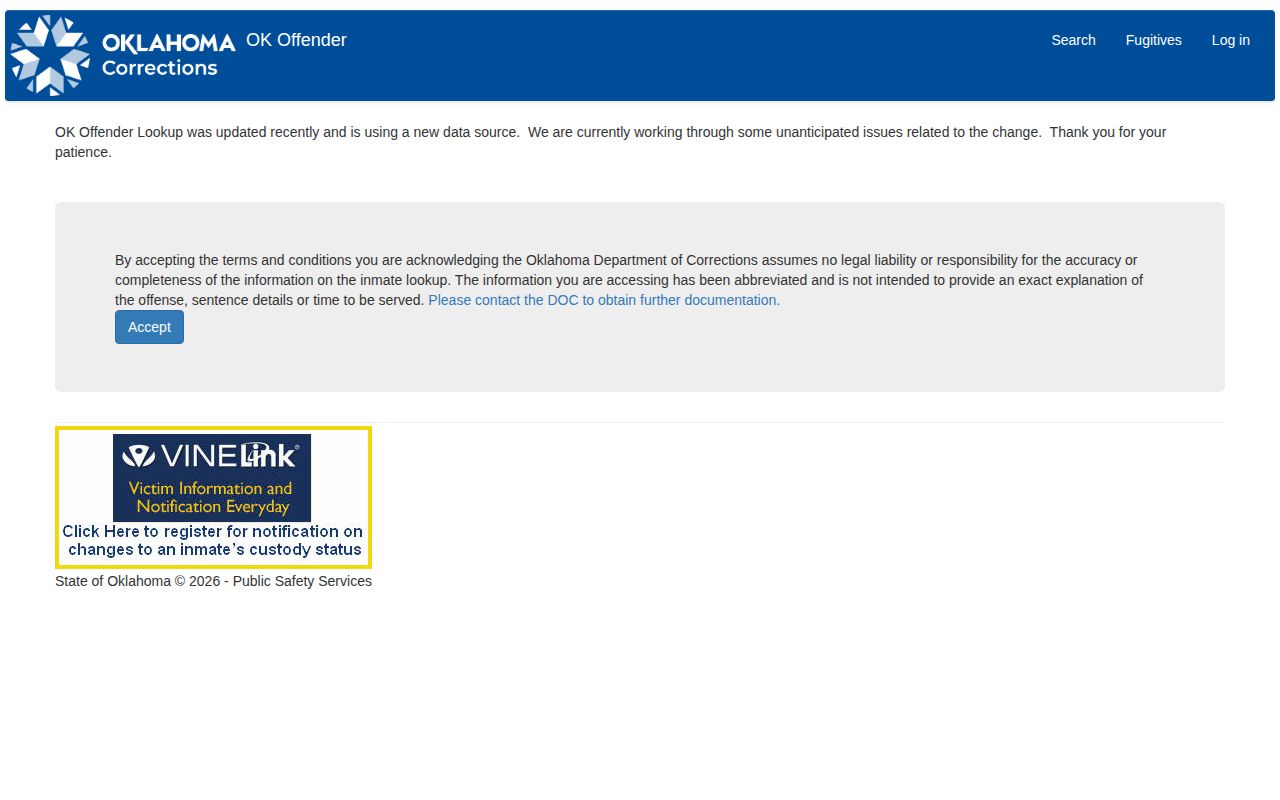
Read status and location together. “Parole” or “probation” can mean community supervision continues. “Discharged” marks the end of the identified ODOC sentence or supervision, while an incarcerated status means ODOC custody has not ended.
Sequoyah Release Roster Limits
The sheriff's roster updates hourly and lists only people in custody. No official recent-release filter, 24-hour view, 72-hour view, or post-release archive was found. The media page publishes daily and weekly arrest reports, which count bookings rather than exits. The official app also advertises inmate details and recent arrests, not a release history.
The Sequoyah County inmate search provides the controlling current-custody view and directs a missing-person search to VINE.
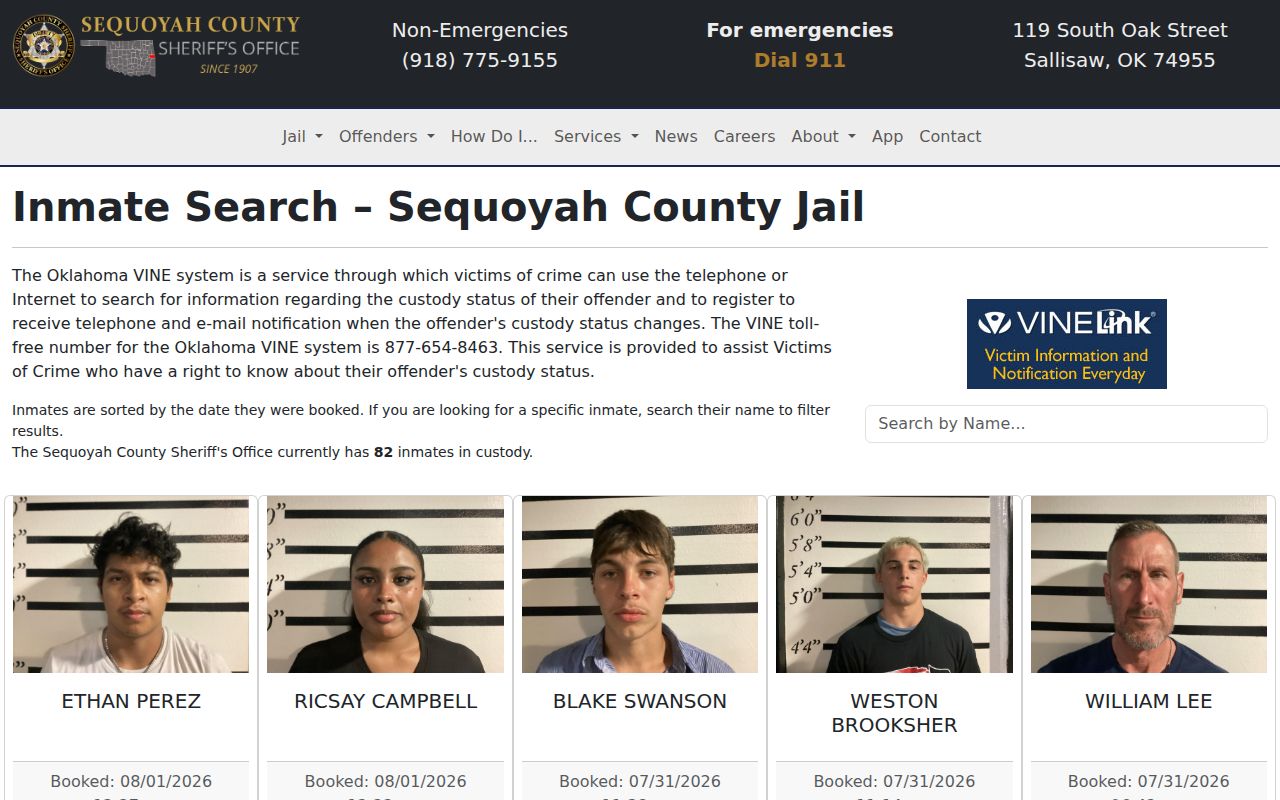
The screenshot illustrates why a current card and a release record answer different questions. Save identifiers while a card is visible, then move to VINE, the jail record, and the court trail after it disappears.
Note: “Updated hourly” describes roster refresh speed, not a promise that released people remain visible for an hour or any longer period.
Sequoyah Release Court Paths
Sequoyah release research can cross city, county, state, tribal, and federal tracks. A Sallisaw municipal arrest may end with city records, municipal court, or transfer to the county jail. Separately, the Cherokee Nation Reservation and Eastern District of Oklahoma create a federal route for some conduct arising in Sequoyah County. A sparse OSCN result and county-roster nonmatch may therefore call for the municipal record or federal docket, not a conclusion that no custody event occurred.
Use the OSCN case search for Oklahoma district-court entries, and obtain the signed order from the Court Clerk when exact legal effect matters.
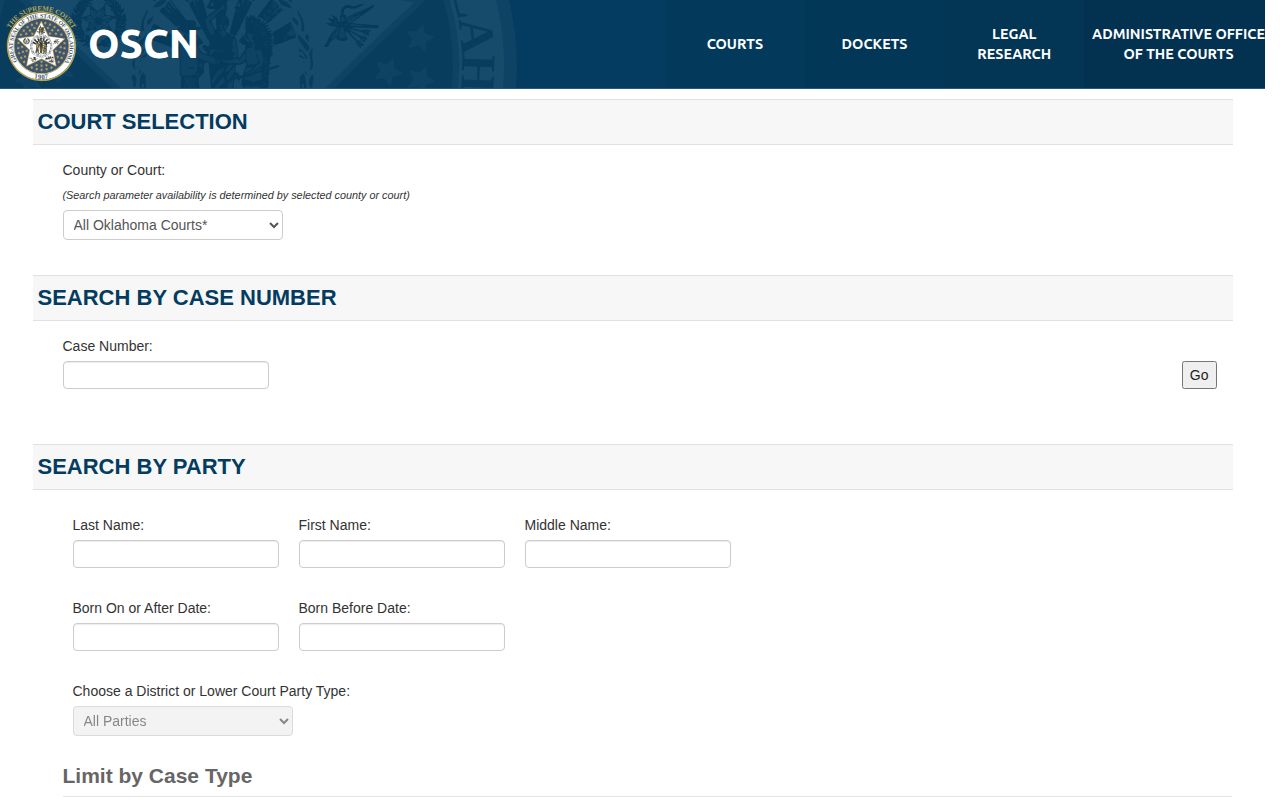
The chronological docket can reveal bond, release order, dismissal, sentence, revocation, or warrant events. Yet the jail record remains the better source for the physical exit time. For a federal sentence, BOP may retain a release date; USMS pretrial movement can require the federal case and official contact instead.
Sequoyah Release to ICE Custody
A February 2026 public-radio report documented an immigration-related detention instance at the Sequoyah County jail. It supports a narrow but important warning: release on the local criminal matter can become transfer to immigration custody rather than community return. No official standing county ICE contract or 287(g) agreement was found, so the reported instance must not be turned into a claim about every release.
Ask the sheriff for the transfer destination, then use ICE Online Detainee Locator. ODLS accepts an A-number with country of birth or name-based biographical data and does not search minors. Its recent-release window is limited. Exact spelling, country of birth, age, and data lag can affect a match, so unresolved cases should follow official ICE ERO guidance.
Historic Sequoyah Release Context
A 2006 Oklahoma corrections audit described a 116-bed trust-authority jail and a 2005 arrangement that held 38 minimum-security ODOC men as jail trustees. That history helps explain why older records may use governance or placement terms that differ from the current sheriff operation. It is dated evidence only.
The old audit does not prove present capacity, contract status, governance, or population. Modern release verification must use current sheriff, ODOC, court, VINE, BOP, or ICE records. Historical numbers should never be used to infer how many people the jail holds or releases now.
Sequoyah Release Status Sources
Choose the system that owns the event. One portal cannot prove every form of Sequoyah County release. The table separates present custody, local exit, state discharge, federal release, and immigration movement.
| System | Strongest use | What it cannot prove alone |
|---|---|---|
| Sheriff current roster | Present county-jail custody | Why a missing person left |
| Sheriff release record | County exit time, type, and destination | Later discharge from a receiving agency |
| Oklahoma VINE | Reported custody event and alerts | Certified release details or every federal event |
| OSCN and court file | Legal order, bond, judgment, and disposition | Exact physical exit or absence of another hold |
| ODOC lookup and records | State custody, supervision, and discharge | A short county stay that never entered ODOC |
| BOP locator | Sentenced federal status and release history | Complete USMS pretrial or ICE custody |
| ICE ODLS | Current or recent immigration custody lead | County criminal disposition |
When two systems conflict, compare the agency, identifier, case, and event date. Then request the originating record. A VINE alert may be timely, a docket may explain authority, and a movement record may establish the actual transfer. Each adds a different part of the proof.
Sequoyah County Release Facilities
The facility map includes verified custody pathways, not a claim that every listed system operates a jail inside Sequoyah County. The county jail is the main adult local facility. Sallisaw's municipal function has dated evidence but no verified separate current release feed. Juvenile records follow confidential OJA and court routes. ODOC, federal, and ICE pages cover transfers beyond local custody.
- Sequoyah County Jail / Sequoyah County Justice Center: sheriff release record, VINE, and court confirmation.
- Sallisaw municipal detention function: city police and municipal records, then county systems after transfer.
- Sequoyah County juvenile intake/detention pathway: authorized OJA and court contact, not an adult roster.
- ODOC prisons and community corrections facilities outside the county: statewide lookup, records, VINE, and parole sources.
- Federal facilities outside the county: BOP locator and federal court records.
- ICE detention pathway: ODLS, ERO guidance, and the county transfer record.
A county-jail transfer is not an ODOC discharge, and a federal release result does not clear an immigration or state hold. Confirm the person and the custodian at each handoff.